
What Is the STR Exam? Everything Texas Teachers Need to Know (2026 Guide)

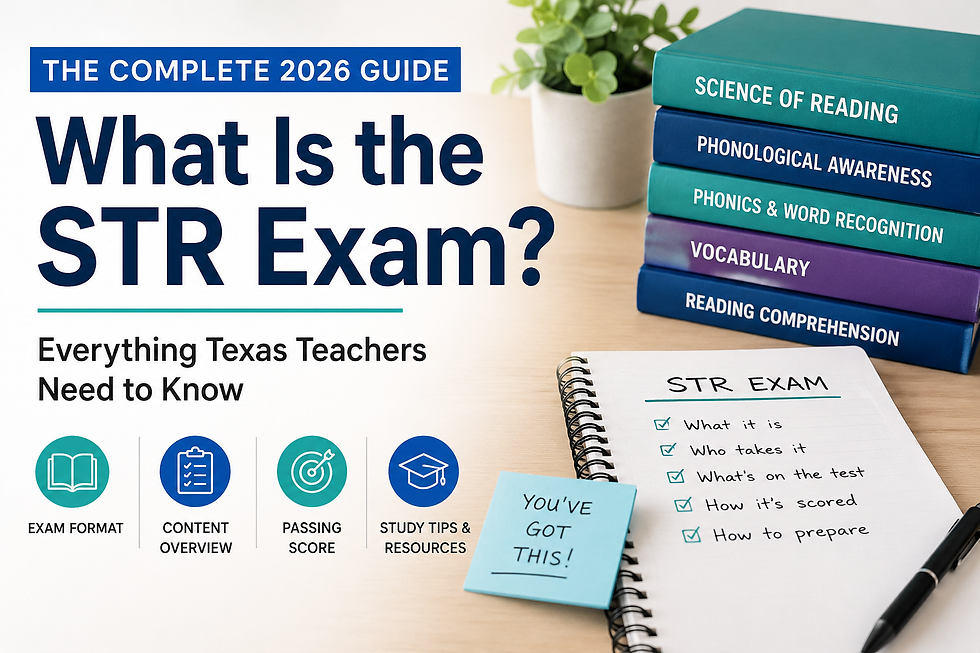
If you're planning to become a certified teacher in Texas, you've probably heard about the Science of Teaching Reading (STR) Exam. For many aspiring educators, the STR is one of the final steps before entering the classroom—and one of the most important.
The good news? With the right preparation and understanding of what to expect, you can approach the exam with confidence.
In this guide, we'll explain everything you need to know about the STR exam, including who needs to take it, what's on the test, how it's scored, and how you can prepare to pass on your first attempt.
What Is the STR Exam?
The Science of Teaching Reading (STR) Exam (293) is a Texas teacher certification exam designed to measure an educator's knowledge of evidence-based reading instruction. The exam focuses on the science of reading and evaluates whether future teachers understand how children develop literacy skills and how to provide effective reading instruction.
The exam is aligned with current research and reflects the instructional practices Texas educators are expected to use in the classroom.
Who Needs to Take the STR Exam?
The STR exam is required for many Texas teacher certification pathways, particularly those preparing to teach young learners where reading instruction is a primary responsibility.
Depending on your certification area and preparation program, you may be required to pass the STR exam before receiving your standard teaching certificate.
If you're unsure whether your certification requires the STR exam, check with your educator preparation program or the Texas Education Agency.
What Is the STR Exam Number?
The official exam designation is:
Science of Teaching Reading (STR) – Exam 293
When registering for the exam, you'll typically see it listed as STR 293.
What's on the STR Exam?
The STR exam covers the knowledge and instructional practices teachers need to support students in becoming successful readers.
Major content areas include:
Reading Development
You'll need to understand how reading skills develop from early childhood through more advanced literacy.
Topics include:
Emergent literacy
Oral language development
Print awareness
Reading progression
Phonological and Phonemic Awareness
This section focuses on helping students recognize and manipulate sounds within spoken language.
You should understand:
Rhyming
Syllables
Beginning and ending sounds
Segmenting
Blending
Phoneme manipulation
Phonics and Word Recognition
You'll be expected to know how students learn to decode words using letter-sound relationships.
Important concepts include:
Letter-sound correspondence
Decoding strategies
High-frequency words
Structural analysis
Multisyllabic word reading
Vocabulary Development
Teachers must know how vocabulary grows and how to teach new words effectively.
Topics include:
Academic vocabulary
Context clues
Morphology
Word-learning strategies
Reading Fluency
Fluent readers read accurately, automatically, and with expression.
You'll learn how to assess fluency and provide instruction to improve it.
Reading Comprehension
This domain focuses on helping students understand what they read.
Expect questions covering:
Making inferences
Main idea
Summarizing
Text structure
Questioning techniques
Comprehension strategies
Reading Assessment
Teachers must be able to analyze assessment data and make instructional decisions based on student performance.
You'll work through classroom scenarios that require identifying student strengths and planning appropriate interventions.
Exam Format
The STR exam consists of:
90 selected-response (multiple-choice) questions
1 constructed-response question
You'll analyze classroom scenarios, student work samples, assessment data, and instructional situations before selecting the best answer.
The constructed-response question requires you to write a professional response using evidence from provided student information.
How Long Is the STR Exam?
Candidates are given five hours to complete the exam.
For most test-takers, this provides plenty of time if they have practiced answering scenario-based questions beforehand.
What Is a Passing Score?
The STR exam uses a scaled scoring system.
To pass, you'll need a minimum scaled score of 240.
Your final score reflects overall performance across the entire exam rather than a fixed percentage of correct answers.
Is the STR Exam Difficult?
Many candidates consider the STR exam challenging—not because the concepts are impossible, but because the questions require you to apply your knowledge rather than simply recall facts.
You'll often be asked to determine:
the best instructional strategy,
the most appropriate intervention,
what assessment data suggests,
or how to support a particular student's reading development.
Success comes from understanding why certain instructional practices are effective.
How Should You Study for the STR Exam?
A structured study plan is one of the best ways to prepare.
We recommend:
Reviewing each exam competency individually.
Learning the Science of Reading concepts rather than memorizing definitions.
Watching instructional videos.
Completing realistic practice questions.
Reviewing detailed explanations for every missed question.
Practicing constructed-response writing.
Taking full-length practice exams before test day.
Studying consistently over several weeks is generally much more effective than cramming during the final few days.
Common Mistakes to Avoid
Many candidates struggle because they:
Memorize instead of understanding concepts.
Skip the constructed-response practice.
Ignore weak content areas.
Study without taking practice exams.
Wait until the last week to begin preparing.
Avoiding these mistakes can significantly improve your confidence and performance on exam day.
Frequently Asked Questions
How many questions are on the STR exam?
The exam contains 90 selected-response questions and one constructed-response question.
How long should I study?
Most candidates benefit from studying consistently over four to eight weeks, depending on their familiarity with reading instruction and available study time.
Can I retake the STR exam?
Yes. If you do not pass, you may retake the exam after meeting the applicable waiting period and registration requirements.
Is the exam multiple choice?
Mostly. The exam includes multiple-choice questions along with one written constructed-response question.
Prepare for the STR Exam with TutoringEZ
Passing the STR exam doesn't have to be overwhelming.
At TutoringEZ, we've helped more than 10,000 future educators prepare for their certification exams with comprehensive study resources designed specifically for Texas teacher candidates.
Our STR Study Bundle includes:
Comprehensive video lessons
Practice questions
Flash cards
Full-length practice exams
Personalized study plans
Expert tutoring options
90-Day Pass Guarantee
Whether you're just beginning your preparation or need help after an unsuccessful attempt, our resources are designed to help you study more efficiently and walk into test day with confidence.
Ready to start preparing? Explore the TutoringEZ STR Study Bundle today and take the next step toward earning your Texas teaching certification.


Comments